Upper Engadine and Silvretta
St. Moritz
 Sunrise
09:03
17:51
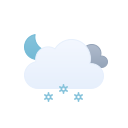
Snow
Sunrise
09:03
17:51
Snow

Hard-to-read day. Persistent or gliding-snow problems can mask the real risk.
Day Risk Profile
Avalanche Problems
 Wind slab + Persistent weak layers
dry
All day
Wind slab + Persistent weak layers
dry
All day
Snowpack & Weather
Snowpack
On shady slopes, the new snow is falling on top of a faceted snow surface and sometimes also surface hoar. Deeper layers are often relatively well consolidated in the extreme west of Lower Valais as well as in the north. South of a line from Rhône to the Rhine, the entire snowpack is often faceted and loose.
The snow depths in all regions are well below average for the time of year.
Weather review for Wednesday
It was sunny and cold in the mountains.
Fresh snow
-
Temperature
At midday at 2000 m, between -13 °C in the north and -9 °C in the south
Wind
Northerly wind:
- Moderate to strong during the night on the Main Alpine Ridge and to the south of it
- Elsewhere light to moderate
Weather forecast to Thursday
Snowfall will set in overnight to Thursday in the west and north and will intensify as the day progresses. The snowfall level will increase from the west from low altitudes towards 1200 to 1400 m.
Fresh snow
From Wednesday evening to Thursday afternoon, the following amounts will fall above 1800 m:
- Northern Alpine ridge west of the Reuss, Valais excluding southern Goms: 15 to 30 cm
- Western Jura, remaining northern flank of the Alps, remaining northern Alpine ridge, Gotthard region, northern Grisons: 5 to 15 cm
- Elsewhere less, dry on the central part of the southern flank of the Alps
Temperature
Pronounced rise in temperatures from the west. At midday at 2000 m, between -2 °C in the west and -8 °C in the east
Wind
Increasingly strong to storm-force westerly to northwesterly wind at high altitudes
Outlook to Saturday
Intense precipitation will fall until Saturday morning, especially in the west and north. The snowfall level in the north will temporarily rise towards 1700 m overnight to Friday and then fall again to low altitudes. The snowfall will be accompanied by a storm-force westerly wind. The intensity of the precipitation will decrease on Saturday. A total of 50 to 80 cm of new snow is expected in the west and north, with up to 1 metre in the extreme west of Lower Valais and northern Lower Valais.
On Friday, danger level 4 (high) is expected to be reached across a widespread area in Valais as well as in some regions on the western part of the northern flank of the Alps and on the northern Alpine ridge west of the Reuss. The avalanche danger will also increase significantly on the remaining northern flank of the Alps and in northern Grisons. In the regions exposed to heavier precipitation, naturally triggered avalanches, including increasingly very large ones, are to be expected. In southern Valais in particular, where the structure of the snowpack is weak, avalanches can sometimes sweep away the entire old snowpack. Due to the low snowfall level, avalanches can carry along a lot of new snow even at intermediate altitudes and advance into the valleys along usual avalanche paths. However, exceptionally large run-out zones are unlikely. Exposed parts of transportation routes may be at risk.
As the day progresses on Saturday, natural avalanche activity is expected to decrease as the snowfall subsides. However, the avalanche danger is expected to remain high (danger level 4).
Issued
8 Jan 06:29 UTC
Valid until
8 Jan 16:00 UTC
Next update
8 Jan 16:00 UTC
Adjoining regions
Get avalanche alerts
Enter your email to receive daily bulletin updates for this region.