
Appenzell - Alpstein
Liechtenstein
 Sunrise
06:40
20:03
Overcast
Sunrise
06:40
20:03
Overcast

Widespread danger. Considerable danger across many aspects, elevations, or problems.
Day Risk Profile
Avalanche Problems
 No distinct problem
dry
All day
No distinct problem
dry
All day
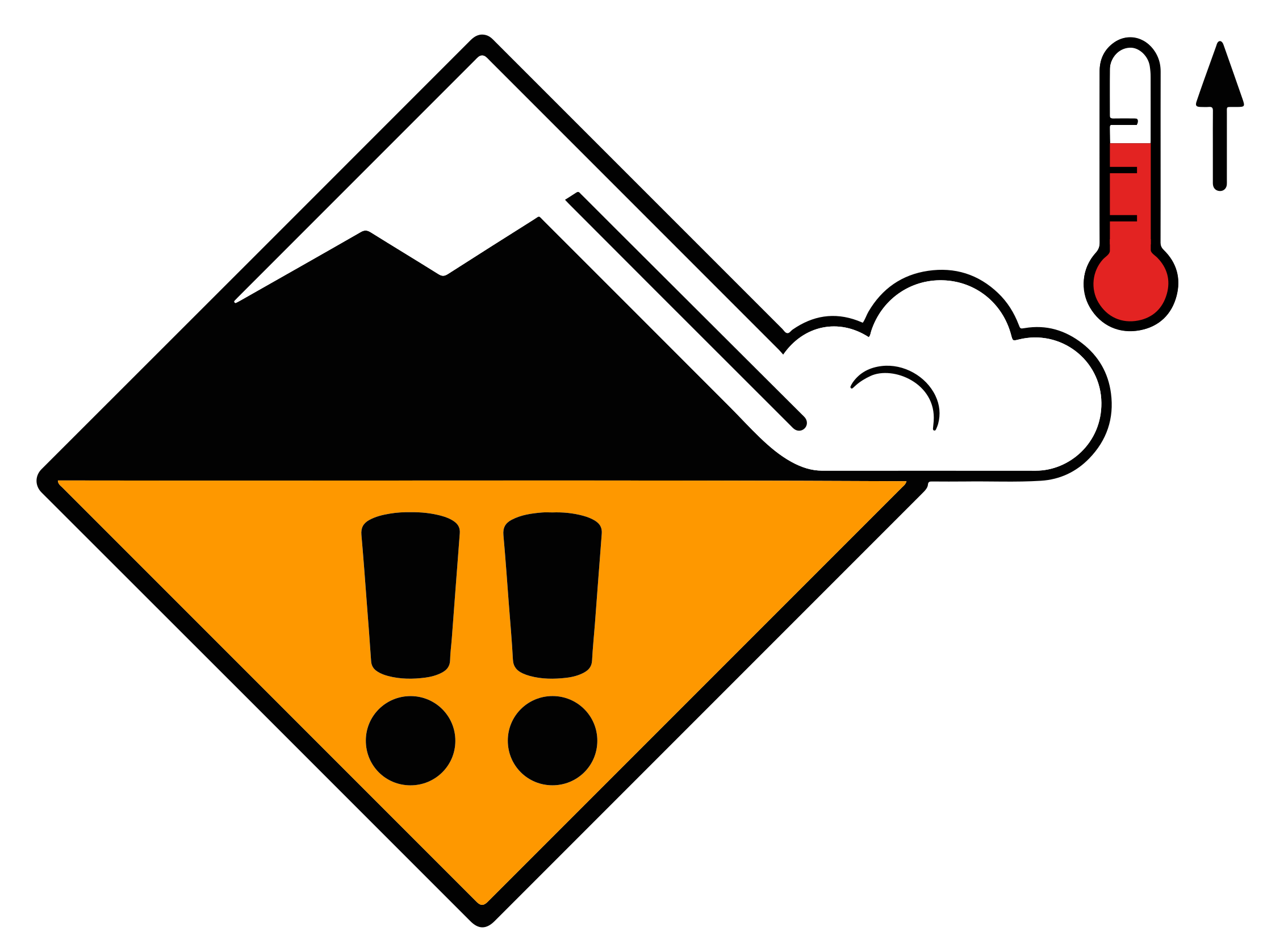 Wet snow
wet
Later
Wet snow
wet
Later
Snowpack & Weather
Snowpack
Weak layers in the upper part of the snowpack can in some cases still be triggered by human activity. Such danger zones are generally located at altitudes where the snowpack is becoming moist for the first time. The likelihood of triggering is increasing during the course of each day. Especially in central Valais and in Grisons, faceted weak layers deeper in the snowpack are also still prone to triggering in isolated cases. This particularly applies to little-used slopes with thin snow cover.
The danger of natural wet snow and gliding avalanches is increasing with daytime rise of temperatures rise and solar radiation. As the day progresses, natural wet snow avalanches are to be expected on sunny slopes below approximately 3000 m and on north-facing slopes below approximately 2400 m.
Weather review for Friday
There were clear spells overnight and and radiative cooling was reduced. Conditions were mostly cloudy in the east during the day. There were a few snow flurries above approximately 2000 m. Conditions were quite sunny in the west and south.
Fresh snow
-
Temperature
At midday at 2000 m, around +4 °C in the north and +9 °C in the south
Wind
Northwesterly, often moderate at high altitudes and strong at times in the east
Weather forecast to Saturday
The first half of the night in particular will often be cloudy. Skies will clear in the west and south during the second half of the night, while the daytime will be mostly sunny. Broken high cloud will move in from the west in the afternoon.
Fresh snow
-
Temperature
At midday at 2000 m between +10 °C in the west and +8 °C in the east and south
Wind
Southwesterly, moderate on the northern flank of the Alps at high altitudes but elsewhere mainly light
Outlook
Sunday
Overnight to Sunday, skies will mostly be clear only in the east and overcast elsewhere. During the day, very sunny conditions will persist for longer in the east. Elsewhere, skies will be cloudy. In the afternoon, a little snow will fall in the far west and on the main Alpine ridge in Valais above approximately 2500 m. There will be an initially moderate southerly wind that will become increasingly strong at high altitudes in the afternoon.
There will be no significant change in dry avalanche danger. Wet avalanche danger will increase in the east as the day progresses. In other regions, the overcast night will mean that wet avalanches are possible from the morning onwards. With some rain, the danger may increase slightly as the day progresses.
Monday
There will be heavy cloud cover and some snow will fall, especially in the south. The snowfall level will be around 2000 m. On the main Alpine ridge from the Great St. Bernard to the Rheinwaldhorn and to the south of there, a widespread 20 to 40 cm of new snow is expected with as much as 50 to 80 cm falling in the heartland of the main Alpine ridge in Upper Valais. Precipitation may extend as far as the Aletsch region. There will be a moderate to strong southeasterly wind. Dry and wet avalanche danger will increase appreciably in the south. The danger level will probably rise to 4 on the main Alpine ridge in Upper Valais. Given heavy rain and snowfall at high altitudes, many naturally triggered avalanches, some very large, are to be expected.
North of the Main Alpine Ridge, dry avalanche danger will increase somewhat with the southerly wind and new snow at high altitudes. Wet avalanches are still to be expected, especially on north-facing slopes below approximately 2200 m.
Issued
11 Apr 06:00 UTC
Valid until
11 Apr 15:00 UTC
Next update
11 Apr 15:00 UTC
Adjoining regions
Get avalanche alerts
Enter your email to receive daily bulletin updates for this region.