Bernese Oberland
westliche Berner Voralpen
 Sunrise
08:59
17:42
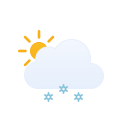
Light snow
Sunrise
08:59
17:42
Light snow

Stable day. Low danger and benign problems — manage as usual.
Day Risk Profile
Avalanche Problems
 No distinct problem
dry
All day
No distinct problem
dry
All day
Snowpack & Weather
Snowpack
Especially on shady slopes above approximately 2400 m and generally in high Alpine regions, there are faceted, long-lasting weak layers deep in the old snowpack. In many places in western regions with heavy snow, these layers are overlaid with deep fresh snow and so can only be triggered by winter sports participants in isolated cases. However, if avalanches are triggered in these deep layers, they can become large. In other regions, the weak old snowpack layers are closer to the surface. Here the snowpack, which is mostly still thin, is becoming completely faceted and loose, meaning that here too avalanches can only be triggered in places. This week's mostly small snowdrift accumulations are in some cases still prone to triggering.
On wind-protected shady slopes, the surface of the snowpack often consists of loose, partly faceted snow and partly surface hoar.
Weather review for Thursday
In the north, conditions were quite sunny in the mountains with broken cloud. There was heavy cloud cover in the south. Above approximately 1300 m, a little snow fell in some localities in the west and south.
Fresh snow
Western Lower Valais, western part of the main Alpine ridge, Ticino: 1 to 5 cm, locally up to 10 cm
Temperature
At midday at 2000 m, between -1°C in the north and -3°C in the south
Wind
Light to moderate from southerly directions, occasionally strong in regions exposed to the foehn wind in the north
Weather forecast to Friday
In the north, conditions will be cloudy at first and a few centimetres of snow will fall above approximately 1000 m by midday. In the south, it will be cloudy during the night and a little snow will fall locally above approximately 1300 m. Conditions will become increasingly sunny from the morning onwards in the south and generally in the high Alpine regions.
Fresh snow
A few centimetres in widespread areas, locally up to 10 cm in northern and central Grisons
Temperature
At midday at 2000 m, around -4°C in the north and -2°C in the south
Wind
Light, becoming northerly
Outlook
Saturday
In the north and Valais, conditions will be mostly cloudy with light precipitation. The snowfall level will rise to between 1200 m and 1600 m. Up to 10 cm of snow will fall in the far west, only a few centimetres elsewhere. Conditions will be fairly sunny and dry in Ticino and Grisons. The wind will freshen, becoming a moderate to strong southwesterly to westerly in the north and generally at high altitudes. Snowdrift accumulations, which are likely to be small but easily triggered, will form and there will be a slight increase in avalanche risk.
Sunday
There will be heavy cloud cover and widespread precipitation. The snowfall level will rise from 1500 m to 2000 m, in the west to 2200 m. In Valais and on the western part of the northern flank of the Alps, 15 to 30 cm of snow falls at high altitudes, less elsewhere. However, the amount of precipitation is still uncertain. Conditions will remain dry in central and southern Ticino and there be sunny intervals during the day. During the night, there will be a moderate to strong westerly wind in the west and north which will elsewhere be light to moderate.
At high altitudes, the risk of dry avalanches will increase in many places, significantly so in the west. In addition, rainy conditions will mean that the risk of gliding avalanches and moist snow slides will increase below approximately 2200 m.
Issued
4 Dec 15:40 UTC
Valid until
5 Dec 16:00 UTC
Next update
5 Dec 16:00 UTC
Adjoining regions
Get avalanche alerts
Enter your email to receive daily bulletin updates for this region.